When pucks are useful
- Tall or shaped containers are unstable on their own base.
- The product must retain a controlled orientation.
- Direct guide contact could mark or deform the container.
- Several stations need the same external handling footprint.
Use a reusable carrier when the container cannot move reliably on its own through filling, capping, labelling, inspection or packing operations.
A puck conveyor system carries each bottle or container inside a reusable holder shaped to support the pack. The puck provides a stable external footprint while the product moves through operations that would otherwise be unreliable because of a narrow base, irregular shape, soft wall, offset centre of gravity or presentation requirement.
The complete project includes more than the forward conveyor. It normally needs a controlled method for loading products into pucks, tracking the carrier through each station, removing the product, returning empty pucks and managing carrier changeover, cleaning and wear. A puck route should therefore be assessed as a line-handling system rather than a simple guide-rail option.
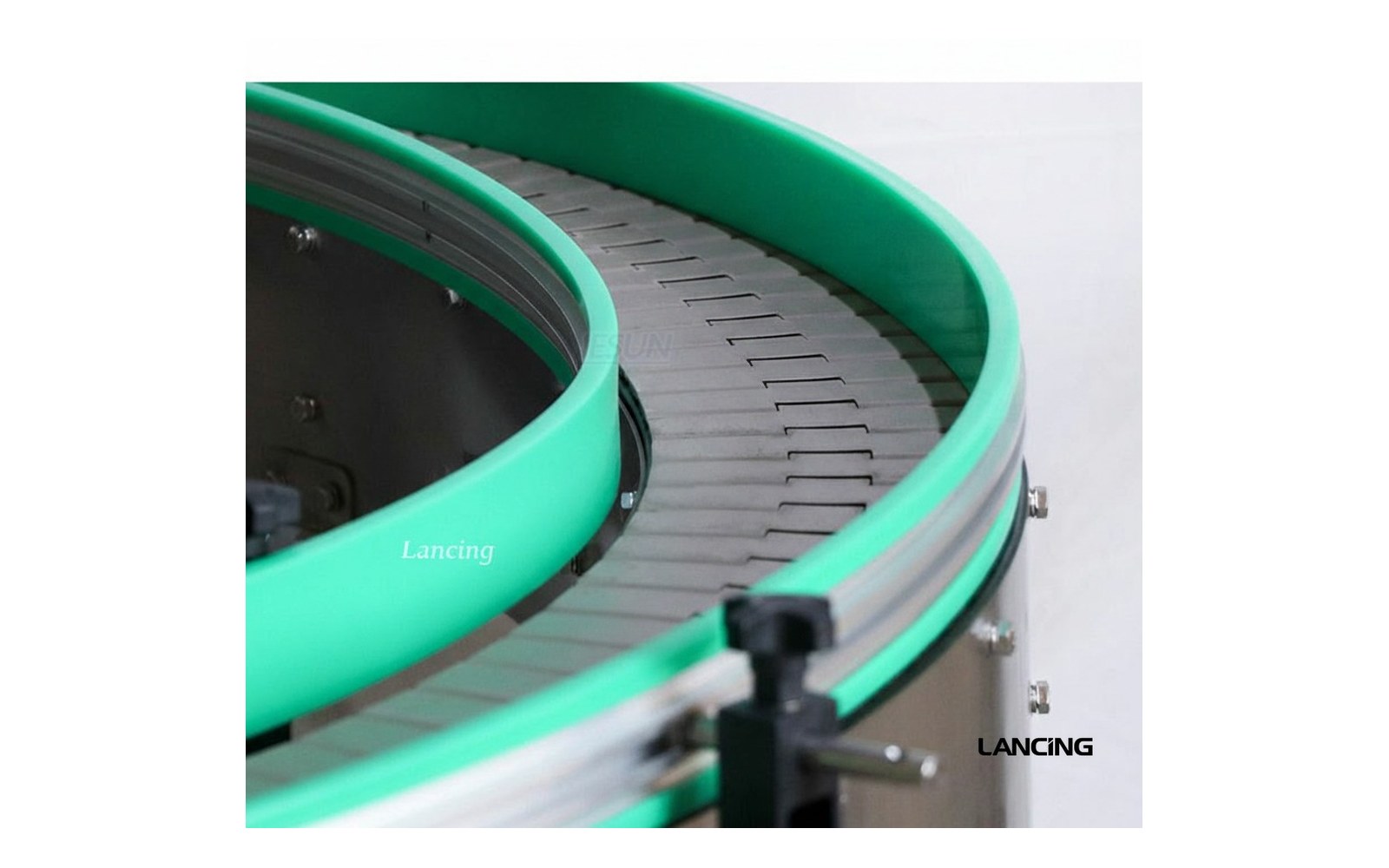
A reliable puck line keeps the product and carrier states controlled throughout the packaging process.
Present the correct bottle to an available puck and confirm that it is seated in the intended orientation.
Move the supported product through filling, capping, labelling, coding, inspection or other stations with the required pitch.
Separate the product without damage and confirm that the puck is empty before it enters the return route.
Return, inspect and queue pucks so the loading station has the correct carrier without creating an uncontrolled shortage.
Choose the support method from the product contact surfaces, required operations and the extent of the stability problem.
| Support route | Best starting point when | Key limitations to assess |
|---|---|---|
| Conventional base conveyor and guides | The pack has a stable base and tolerates normal side-guide contact. | Base size, guide height, transfer gaps, back pressure and changeover range. |
| Side-grip conveyor | The product can be supported on two side surfaces and base access is needed. | Wall stiffness, grip contact, width variation, release transfer and marking risk. |
| Puck conveyor system | The product needs a stable carrier through several operations or must retain orientation. | Carrier loading, de-pucking, return loop, footprint, carrier inventory, cleaning and wear. |
| Local indexing fixture | The pack is stable in transit but needs support at one defined station. | Station cycle, positioning, fixture changeover and queue control. |
Use representative products and the complete line sequence. A carrier that fits one bottle in isolation may still obstruct a filling head, label path, inspection view or de-pucking operation.
| Design subject | Questions to answer | Evidence to retain |
|---|---|---|
| Product location | Which surfaces locate the pack, and how is height or orientation controlled? | Representative products seated and removed without damage or excessive movement. |
| Station access | Does the puck leave the neck, cap, label, code and inspection areas accessible? | Product and carrier checked at every packaging operation. |
| Carrier identity | Are pucks common across formats, dedicated, colour coded or electronically identified? | Approved format matrix and incorrect-carrier response. |
| Loading and unloading | How are product and puck availability synchronised? | Normal, missing-product, missing-puck, jam and recovery tests. |
| Return route | How many pucks are needed, where do they queue and how are empty carriers confirmed? | Complete circulation trial at normal production and after a short stop. |
| Cleaning and inspection | Can product-contact risks, debris and carrier damage be identified and managed? | Cleaning method, inspection criteria and rejected-puck process. |
| Changeover | Which carriers, guides, sensors and recipes change by format? | Repeatable settings, carrier count and post-changeover validation. |
The control system should know whether a puck is empty, loaded, correctly seated and available for the next operation. If the product is rejected or removed, the carrier still needs a defined route. If a puck is damaged or the wrong format is present, the system should prevent it reaching a station where it could cause a collision or quality fault.
Define product detection, puck detection, loading confirmation, station permissions, reject handling and return-loop availability with the product-detection sensor guide and controls and interlocks guide.
Pucks can introduce recesses, contact surfaces and a separate inventory of parts. Define whether the product or process can contaminate the carrier, how pucks are cleaned and dried, how damaged carriers are identified and where unused formats are stored. Cleaning requirements should be based on the real product and production environment, not the puck material name alone.
Where several pack formats are planned, decide whether one adjustable carrier is realistic or dedicated pucks give a safer, more repeatable location. Include carrier quantity, identification, wear criteria and replacement control in the handover documentation. Use the cleaning and changeover checklist and critical-spares guide.
A puck conveyor is a strong option when the bottle cannot remain stable or correctly oriented through several packaging operations using its own base and ordinary guides. It is most useful when one carrier can solve a repeated handling problem across filling, capping, labelling, coding or inspection. The benefit must be weighed against carrier loading, return, cleaning and changeover complexity.
A puck supports the product inside a reusable carrier that travels with it. A side-grip conveyor holds the product between two moving side belts and normally releases it after the controlled section. Pucks can maintain a common footprint and orientation through several stations; side grip is useful for temporary base access or a local unstable transfer when the walls can tolerate contact.
Sometimes, but only when the location, clearance and stability remain acceptable for every format and packaging station. A broadly adjustable carrier may reduce part count but can provide less repeatable support. Compare a common puck with dedicated carriers using the smallest, largest and least stable samples, then document which formats share a verified setup.
The required quantity depends on the complete circulation time, line pitch, operating sequence, queue positions, loading availability and the number held outside the route for cleaning or maintenance. Count pucks across the forward path, processing stations, unload, return and buffer locations, then add an agreed operational reserve based on the real line design.
It can be considered if the carrier keeps the product stable while leaving the required label application and wipe-down surfaces accessible. The puck must not obstruct the label path, sensors, code area or machine guides. Test the actual product, label and carrier through the labeller, including changeover and reject conditions.
Provide representative bottles, drawings, tolerances, filled weights, closures, orientation needs, every packaging station, target good output, loading and unloading concept, available footprint, cleaning method and expected format range. Include which product surfaces may be contacted and any areas that must remain clear for filling, capping, labelling, coding or inspection.
Include representative formats, filled states, contact restrictions, orientation needs, target good output and available return-route space so Lancing can review the handling options.