Merge several lanes into one
Meter the incoming streams so products enter the downstream lane without overlap, side contact or an uncontrolled surge.
Combine multiple lanes, divide one flow or restore a controlled single file before coding, inspection, packing or another packaging machine.
A lane merge combines two or more product streams into a controlled downstream flow. A lane divider or diverter sends one incoming stream to two or more destinations. A singulation section takes products that are grouped or side by side and presents them in a predictable single file for a downstream machine.
The design must balance product behaviour with downstream capacity. Guide rails alone may be enough for a stable, well-spaced product, while irregular packs, higher queue pressure or multiple destinations may require controlled speed zones, sensors, gates, pushers or another application-specific mechanism. The correct method is proved with the real product and line states.
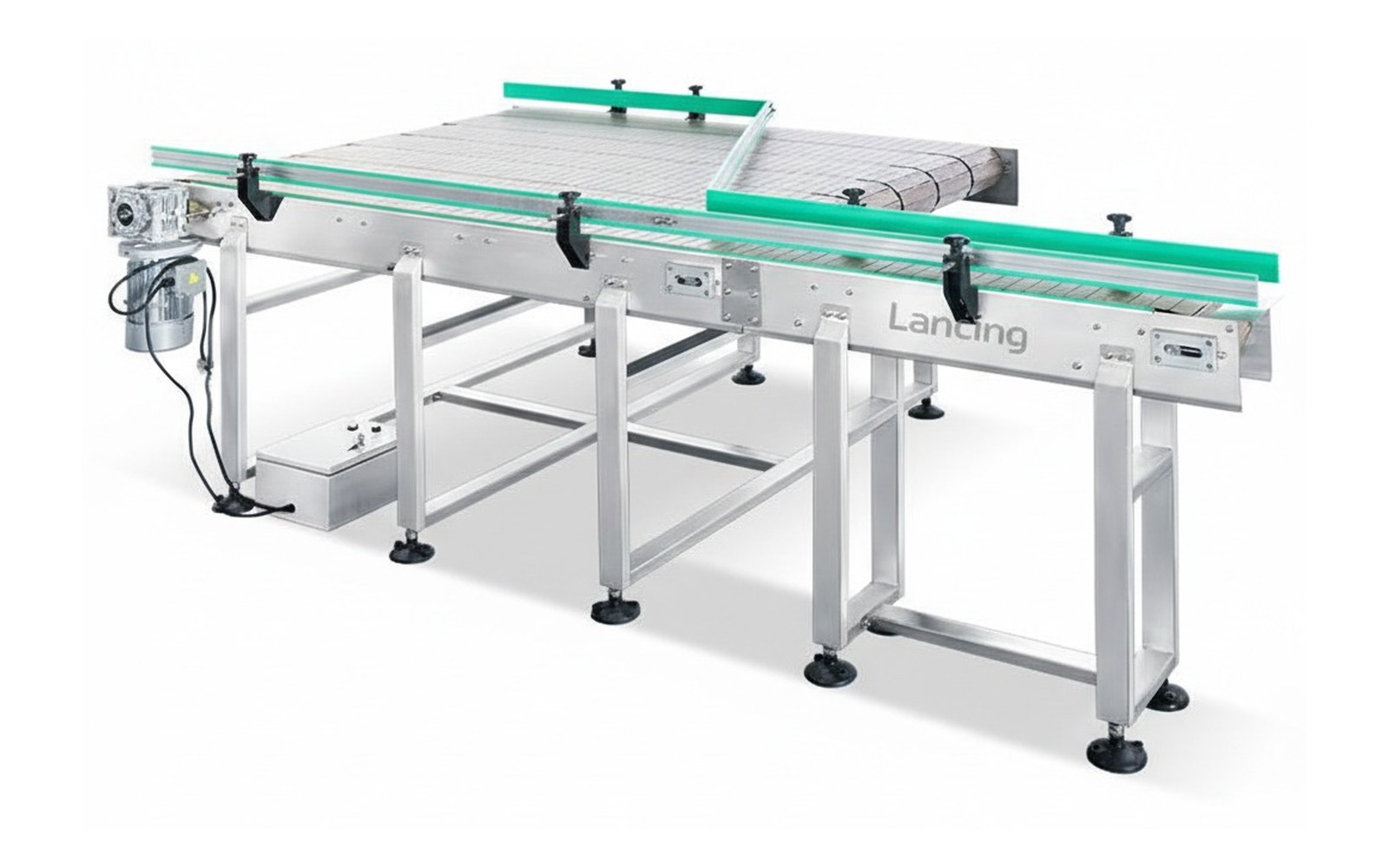
Meter the incoming streams so products enter the downstream lane without overlap, side contact or an uncontrolled surge.
Route products to parallel machines, inspection outcomes, packing stations or alternative process paths with destination confirmation.
Separate and align products before coding, checkweighing, inspection, labelling, case packing or another station that needs one product at a time.
Define the incoming condition, required outgoing condition and abnormal states. The name of the mechanism does not define whether the product will remain stable.
| Design subject | Questions to answer | Acceptance evidence |
|---|---|---|
| Incoming flow | How many lanes arrive, at what pitch, and can lanes stop independently? | Recorded lane states at normal production, starvation, blockage and restart. |
| Product behaviour | Can packs touch, slide laterally, rotate or queue without damage? | Representative products merged or divided without unacceptable scuffing, tipping or overlap. |
| Downstream capacity | Can the receiving machine accept the combined peak or only a controlled average flow? | Release sequence matched to the downstream ready and blocked states. |
| Detection | Where are product presence, gap, lane occupancy and destination confirmed? | Sensor tests with the least favourable product surface and spacing. |
| Routing logic | How is the destination selected and what happens when it is unavailable? | Witnessed normal, full-destination, failed-actuation and recovery tests. |
| Changeover | Which guides, timing values, sensors or mechanisms change by format? | Repeatable settings and a product-specific verification check. |
| Safety and access | How can jams be cleared without access to dangerous movement? | Machine-specific guarding, isolation and safe-access record. |
Combining two lanes does not mean the receiving machine can accept both streams at their uncontrolled peak. The merge normally needs an agreed release rule, spacing target and queue strategy. Where the downstream machine is blocked, the upstream lanes may need to stop, accumulate independently or divert to an alternative route.
Calculate the required operating states rather than relying on a single nominal line speed. Include starvation of one lane, both lanes full, one sensor failed, a destination unavailable and restart after a short stop. Use the speed and product-spacing guide and accumulation calculation guide to define the inputs.
| Method family | Useful when | Points to prove |
|---|---|---|
| Fixed guides and speed relationships | Products are stable, well spaced and can move laterally without damage. | Guide contact, product rotation, minimum gap and behaviour during restart. |
| Controlled speed zones | Incoming streams need metering before a common lane. | Gap creation, queue pressure, sensor positions and downstream demand. |
| Gate, pusher or diverter | Products need an active destination decision. | Actuation timing, product contact, position confirmation and failed-actuation response. |
| Shuttle or moving lane | A lane must align with several fixed destinations. | Motion envelope, access, product retention and destination interlocks. |
| Carrier or puck routing | The product cannot tolerate direct guide contact or must retain a controlled orientation. | Carrier loading, tracking, destination logic, return route and changeover. |
A diverter should not act on an untracked product. The control sequence needs a reliable trigger, product-to-decision association, actuation window and confirmation that the product reached the intended path. Where the decision comes from an inspection system, use the coding and inspection conveyor guide and reject handling guide.
For a merge, the receiving machine should publish a usable ready or blocked state. For a divider, each destination needs an availability rule and a defined response when full or faulted. The final sequence should be tested with representative products and deliberate faults.
Two lanes are merged by controlling the timing and lateral path of each product so only one pack enters the shared downstream position at a time. The method can use guides, different speed zones or an active mechanism. Product stability, minimum gap, downstream capacity and blocked-line behaviour determine which approach is appropriate.
A conveyor diverter sends products from one incoming route to a selected destination. It may feed parallel machines, separate accepted and rejected packs, balance packing stations or route formats to different processes. The system needs a reliable product decision, correctly timed movement and confirmation that the product reached the intended lane.
Singulation means converting a grouped, touching or multi-lane product flow into a predictable one-at-a-time stream. It is often required before checkweighing, coding, inspection, labelling or automatic packing. The design must create a usable gap without tipping, overlapping or losing product orientation.
It may need short queue capacity because the receiving lane or machine cannot always accept every arriving product immediately. The buffer can sit in each incoming lane, before the merge or after it, depending on product contact limits and the control sequence. Define how long each lane must wait and how it should recover after a blockage.
Product width, length, base, centre of gravity, stiffness and acceptable contact determine guide positions, timing and the minimum gap. A setting that merges cartons may not control pouches or tall bottles. Record repeatable guide and sensor settings for every format and test the limiting product through normal and recovery states.
Provide every pack format, lane count, incoming pitch, target outgoing condition, destination rules, downstream capacity, machine signals, measured layout and representative samples. Include photographs or video of the current flow and describe what should happen during starvation, blockage, reject, full-destination and restart conditions.
Include the pack formats, lane arrangement, pitch, target output, downstream machine states and measured layout so Lancing can review the merge or divert duty.